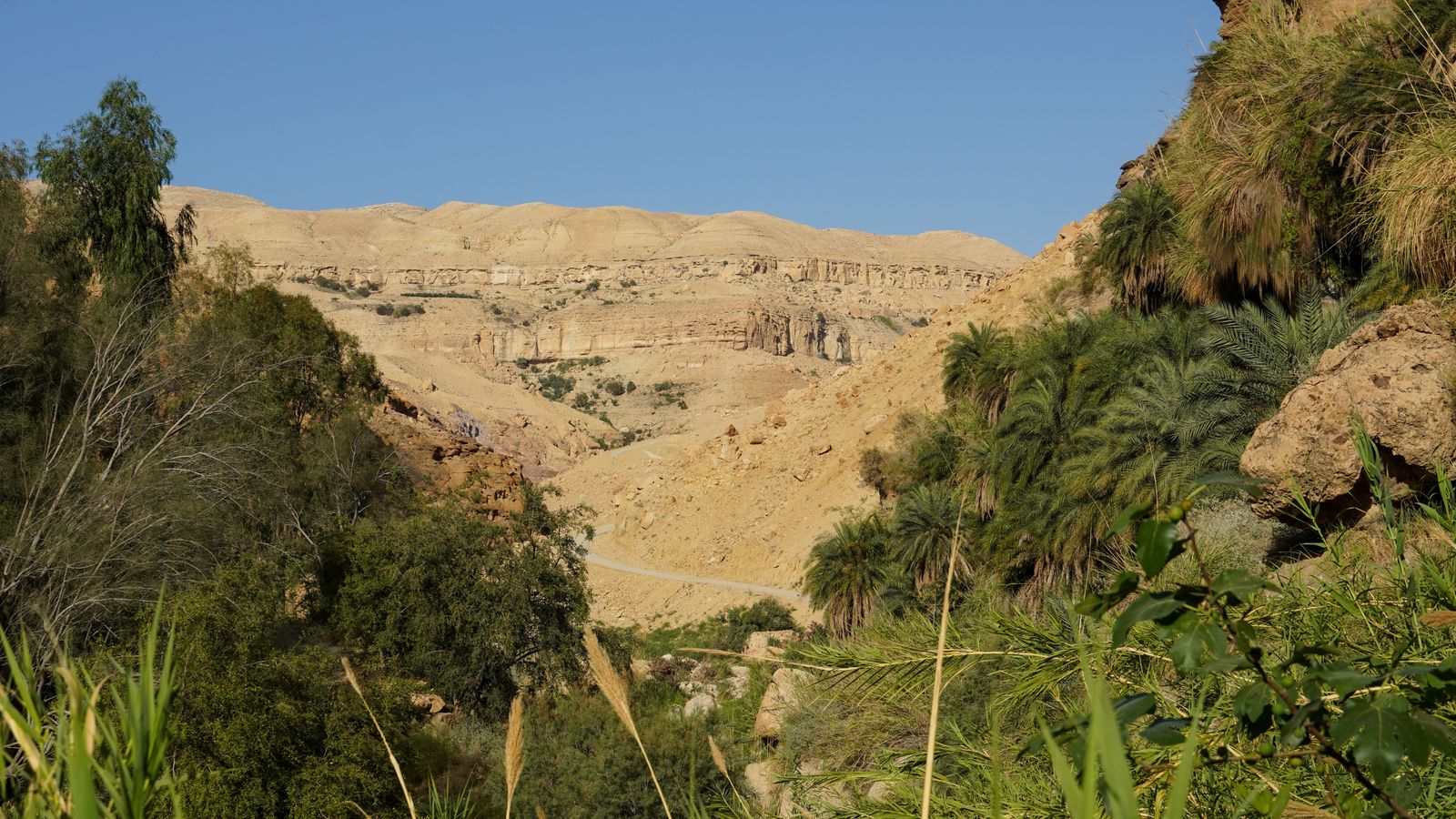
The complete guide to Tahquitz Canyon
There is a 60-foot waterfall roughly a mile from downtown Palm Springs. You can walk to the trailhead from a decent hotel. Most visitors never see it, because for thirty years you legally could not, and the habit of ignoring it has outlived the closure by a quarter century.
Tahquitz Canyon is the best short hike in Palm Springs and one of the few places in the valley where the scale of the San Jacinto range makes sense from the ground rather than from a tram window. It is also sacred ground with a genuinely complicated history, and the tribe that owns it is explicit about how it wants visitors to behave. Both of those things are worth understanding before you go.
Tahquitz Canyon Trail Overview
The main trail is a 1.8-mile round trip with about 350 feet of elevation gain, rated moderate, and takes most people 1.5 to 2 hours. You'll see it listed anywhere from 1.7 to 2 miles depending on who measured and where they turned around; the difference doesn't matter.
What does matter is the surface. This is not a graded path. Much of the climb is on natural and placed rock steps, and plenty of them are 12 to 15 inches high — a genuine step-up, repeated, on the way in and the way down. If your knees are unhappy about stairs, they will be unhappy here. Trekking poles are not overkill.
At the top you reach Tahquitz Falls: a 60-foot seasonal waterfall dropping into a pool below 200-foot canyon walls. The canyon floor holds a seasonal creek, and the whole route passes an old Cahuilla village site.
The trail loops rather than doubling back on itself, which means the return leg gives you the canyon from a different angle instead of the same view in reverse.
Tickets & Visitor Center Hours
Everything starts at the Tahquitz Canyon Visitor Center, 500 W Mesquite Ave, half a mile west of Palm Canyon Drive. You buy admission there, watch the short film if you want the context, and enter through the gate.
Admission: $15 for adults, $7 for children ages 6 to 12, free for under-5s and for active U.S. military with valid ID. An annual pass is $125, which pays for itself on the ninth visit and is a real consideration if you're local.
Hours: 7:30am to 5pm. The canyon is open daily from roughly early October through the Fourth of July, and Fridays through Sundays only during the deep summer, roughly early July through the end of September. The last hikers are allowed onto the trail at 3:30pm, and everyone has to be out of the canyon by 5pm.
Dates for the seasonal switch shift slightly year to year, so check the official site before you plan around them.
Ranger-led hikes are included with admission and run several times a day in the cool season, with a reduced schedule in summer. They take about two and a half hours and are led by Agua Caliente tribal rangers. If you have the time, take one. The self-guided version is a nice walk; the guided version is the reason the canyon is interesting.
The canyon caps the number of people on the trail at once. In peak season the gates have been known to close for capacity well before mid-morning. Arrive at opening on a spring weekend, not at 10am.
The Agua Caliente History
The canyon belongs to the Agua Caliente Band of Cahuilla Indians, and it is not merely scenic to them.
In Cahuilla tradition, Tahquitz — Táhkwish — was the first shaman created by Mukat, the creator. He used his power to protect and guide the people, and then he turned it against them. He was banished to this canyon, and he is understood to still be here, present in thunder, lightning, sudden wind, and meteors, still consuming the souls of those who come too close. Some tribal members will not enter the canyon at all. That belief is thousands of years old and it is not a marketing device.
The modern history is more recent and blunter. In April 1969, a rowdy crowd left a rock concert in Palm Springs and descended into Tahquitz Canyon to keep partying for days. What followed was three decades of trespass: squatters living in the rock shelters, garbage on the canyon floor, and ancient pictographs spray-painted over. The tribe closed the canyon. The "No Trespassing" signs, fences, and gates did not fully work.
In 1997 and 1998 the tribe committed to a cleanup that cost over $100,000 and took three years — crews hiking generators and pressure-washing equipment in to blast paint off boulders, because there is no vehicle access to the falls. In January 2001 the canyon reopened for ranger-led group hikes, and that March the general public was allowed back for self-guided hiking for the first time in a generation. The visitor center opened the same year, funded by tribal enterprise revenue.
Then-Tribal Chairman Richard M. Milanovich framed the cleanup as an act of reclamation rather than tourism. The tribe has said it asked its ancestors' forgiveness for opening the canyon in order to protect it.
The rules follow from all of that, and they are strict: no pets, no fires, no smoking, no alcohol, no drones, no bikes, no firearms, no amplified music, no lingering after dark, and no leaving the marked trail. Cultural sites are not to be touched. Visitors 17 and under must be with an adult, and you must be 18 to enter alone.
Tahquitz Canyon and the Indian Canyons — Palm, Andreas, and Murray — are both part of the Santa Rosa and San Jacinto Mountains National Monument, jointly managed with the U.S. Forest Service and the BLM. The tribe runs them as two separate units, with separate gates and separate tickets.
Waterfall Season Timing
This is the make-or-break variable and the one most people get wrong.
The falls are seasonal. Flow is strongest in winter and spring, generally peaking somewhere between February and April, and the single best predictor is recent rain. Go a day or two after a storm and it thunders. Go in late June and you may find a wet streak on rock.
If the waterfall is the point of your trip, check the forecast history rather than the calendar. If the hike is the point, the canyon is worth it dry — the geology, the village site, and the walls do not depend on water.
A film note for the completists: the falls appear in Frank Capra's Lost Horizon from 1937, in the scene where a woman rides a horse into the pool.
What to Bring
The canyon has very little shade, no restrooms on the trail, and no water fountains. Plan accordingly.
- Water. A minimum of 32 ounces per person is required to enter, and that is a floor, not a recommendation. In warm months bring twice that.
- Real shoes. Trail runners or hiking shoes. The rock steps are uneven and the descent is where people roll ankles in sandals.
- Sun protection. Hat, sunglasses, sunscreen. There is nowhere to hide from the sun on most of this trail.
- A small pack, so your hands are free for the rock steps.
- Cash or card for admission, paid at the visitor center on arrival.
Start before 9am in summer, and honestly before 8am from May onward. The canyon holds heat by late morning — the rock walls radiate it back at you — and the return leg in the middle of the day is meaningfully harder than the climb was.
Nearby Trails
Indian Canyons is the other Agua Caliente hiking property, and the two are constantly confused. Different entrance, at the tollgate on S Palm Canyon Drive several miles south of downtown, different hours, and a separate ticket at $12 per adult, which covers Palm Canyon, Andreas Canyon, and Murray Canyon on one admission. If you want a longer day or a shadier walk under fan palms, that's the one.
Two easy contrasts worth knowing: Andreas Canyon is a one-mile loop and the gentlest real hike in Palm Springs. Murray Canyon runs roughly four miles out and back with about 600 feet of gain, and leads to its own set of seasonal falls with far fewer people at them.
And if you want elevation rather than canyon, the Palm Springs Aerial Tramway puts you in a pine forest with a 40-degree temperature drop in under fifteen minutes, which is a different trip entirely and the correct answer on a 108-degree day.
Good to know
No. The canyon is Agua Caliente tribal land and no animals are permitted on the trail. Fires, smoking, alcohol, bikes, drones, firearms, and amplified music are prohibited as well, and hikers must stay on the marked trail.
Keep exploring
Get The Desert Weekender
A weekly email with new guides, events, and hidden gems. No spam, just sun.