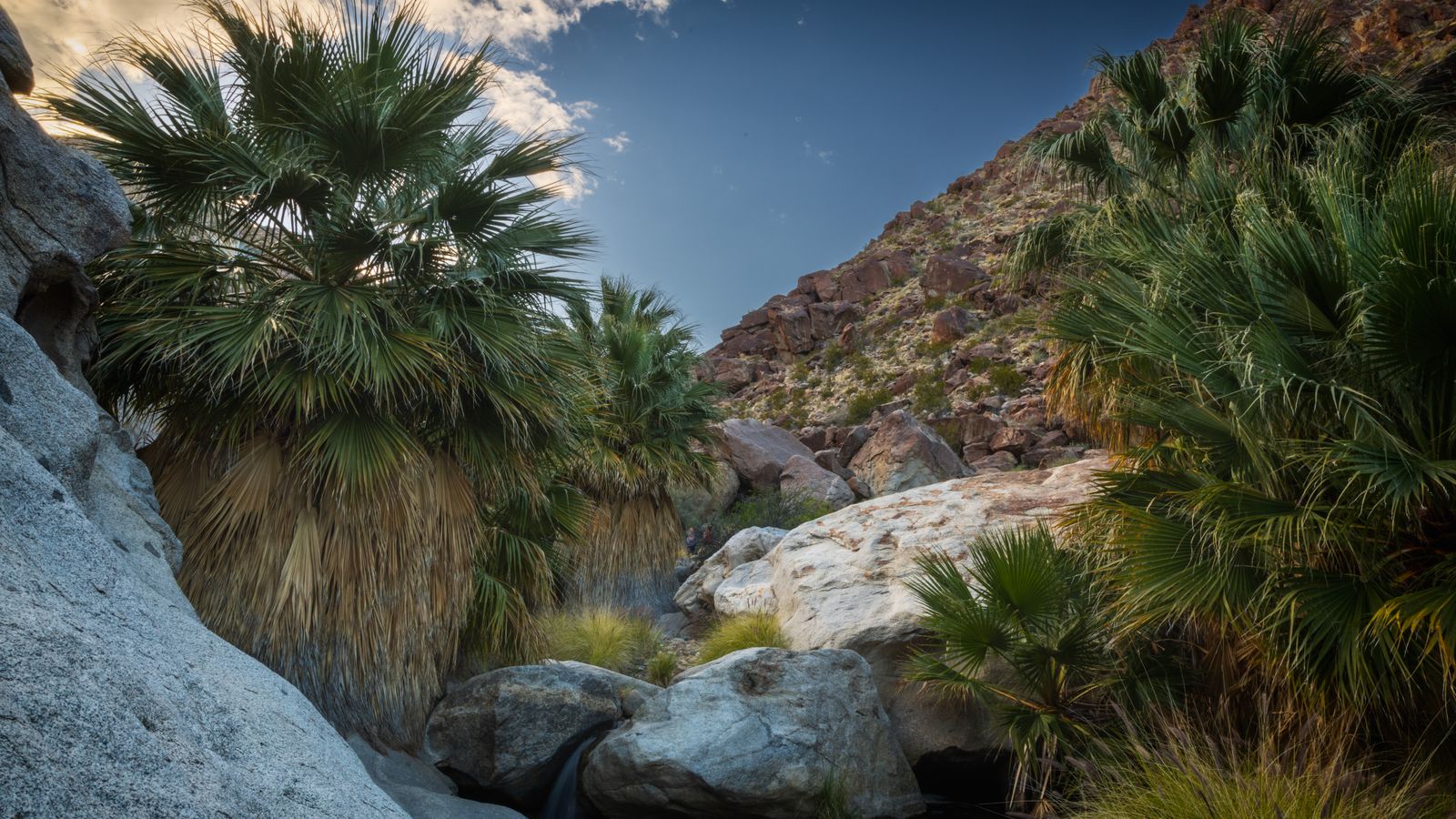
Indian Canyons Palm Springs: Hiking Guide
Ten minutes south of downtown Palm Springs, the road runs into a tollgate, and behind it are three canyons holding what is genuinely the largest natural stand of California fan palms anywhere on earth.
Most visitors go to Tahquitz Canyon instead, because it has a waterfall and better signage from town. Tahquitz is excellent. But Indian Canyons is bigger, cheaper, greener, and gives you a choice of walks from twenty minutes to a full day — and the fan palm groves in Palm Canyon are the thing people remember about hiking in this valley years later.
Here's how to pick.
Tickets & Hours
Everything runs through the tollgate at 38520 S Palm Canyon Drive, which is simply the continuation of the road south past the last houses.
Admission: $12 adults · $7 seniors 62+ · $7 students with ID · $6 children 6–12 · free under 5 · free for US military with ID · $11 equestrian. An annual pass is $125 and pays back at the eleventh visit. Tribal members enter free.
Tickets are sold at the tollgate and at the Agua Caliente Visitor's Counter at 2901 N Palm Canyon Drive. Some online sale is available but in limited quantities, and annual passes are in-person only — so plan on paying at the gate.
Hours: 2 October to 5 July, daily 8am to 5pm, with the last vehicle admitted at 4pm. 6 July to 1 October, Friday to Sunday only, same hours. The property closes for Thanksgiving, and the tribe posts occasional week-long closures as a banner on its homepage — two happened in 2026. Check before you drive out.
Age rule: you must be 18 to enter alone, and anyone 17 or under must be accompanied by an adult.
Ranger-led hikes are free with admission and run October through June only. Friday to Sunday there's a 10am walk from the Trading Post into Palm Canyon — about a mile, an hour and a half — and a 1pm walk of the full Andreas loop. Monday to Thursday it's 30-minute ranger talks instead, at 10am at the Trading Post and 1pm at the Andreas parking area. Take one. The canyons are pretty on your own; they're interesting with a Cahuilla ranger.
Palm Canyon Trail
This is the reason to come.
Palm Canyon runs fifteen miles from the trailhead, and holds the world's largest natural stand of Washingtonia filifera — the only palm native to California. The reserve covers over 3,000 acres and something in the region of 2,500 mature trees. Standing under them, in a gorge, in a desert, with a stream running through, is genuinely disorienting the first time.
The Trading Post sits at the trailhead about two and a half miles in on the main road — maps, cold drinks, and Cahuilla pottery, baskets and jewellery — and the trail drops down from there into the grove.
Most people walk about two miles round trip with roughly 250 feet of gain, going down into the canyon floor, along the palms, and turning around near the East Fork junction. That's an easy hour and a half and it gets you everything the canyon is famous for. If you want more, the trail keeps going for another dozen miles and connects into a network of over 60 miles across the property.
Andreas Canyon
1.2-mile loop, rated easy. The gentlest real walk in Palm Springs and the best one to bring people on who don't hike.
The loop follows Andreas Creek, which runs year-round, out one bank and back the other beneath fan palms and past some genuinely strange rock formations — folded, tilted, striped. More than 150 plant species grow within half a mile of here, which is a remarkable density for a desert, and you'll pass bedrock mortars and metates where Cahuilla families ground mesquite and acorns for generations.
There are picnic tables at the parking area. This is the canyon to spend a slow morning in rather than to conquer.
Murray Canyon
4.7 miles, rated moderate, and the one that most rewards effort.
The trailhead is at the south end of the Andreas parking area, and the walk runs up a quieter canyon to the Seven Sisters — a stacked series of small seasonal waterfalls in a fan palm grove. Expect somewhere in the range of 450 to 650 feet of gain and around ten creek crossings, several of which involve rock-hopping. In winter and spring, when the water is actually running, bring shoes you don't mind soaking.
Murray sees a fraction of Palm Canyon's traffic, which is the point. It's also the best wildlife on the property: peninsular bighorn sheep on the walls above, mule deer in the wash, and nesting Least Bell's Vireo, an endangered songbird, in the streamside thickets.
The falls are seasonal. February through April after rain is when they perform; by June there may be nothing.
The Rules, and Why They Exist
This is tribal land, not a park, and the Agua Caliente are specific about conduct:
No animals of any kind. This is the rule visitors get wrong most often, because a number of dog-travel blogs list Indian Canyons as dog-friendly. It is not. The posted rule is "no animals," and it applies across all three canyons.
Also prohibited: fires, smoking, alcohol, bicycles, rock climbing, drones, firearms, and leaving the marked trail. Cultural sites are not to be touched.
Carry a quart of water per person per hour, and turn back when you've used half of what you brought. That is the tribe's own guidance and it is the right number in this climate.
From 6 July to 1 October the canyons open Friday to Sunday only, and there are no ranger programmes at all in July, August or September. Combined with average highs above 100°F for those three months, summer here is a weekends-only, dawn-only proposition. If you're visiting in August, be at the tollgate at 8am or don't come.
Best Time to Visit
October through May is the season, without qualification. December through March is close to perfect — 70s in the day, water in the creeks, wildflowers in a good year.
Morning always. The canyons face in ways that hold heat, and the last vehicle is admitted at 4pm anyway, so an afternoon start gives you a hot walk and a rushed exit.
After rain for Murray Canyon, if the falls are what you want. February to April is the window.
Riding Instead of Walking
Indian Canyons has official equestrian access — the $11 equestrian pass, $150 annually — and Smoke Tree Stables runs guided rides up Murray Canyon for around $185 a person, closed Wednesdays. It is an unusual thing to be able to do ten minutes from a mid-century hotel pool, and for people who don't want to hike four miles it's the only way to see the upper canyon.
Indian Canyons vs. Tahquitz Canyon
The most common confusion in Palm Springs hiking, so plainly:
Tahquitz Canyon — 500 W Mesquite Avenue, $15 adults, a 1.8-mile round trip on rock steps to a 60-foot seasonal waterfall, ranger-led hikes included, visitor centre with a film. Dramatic, compact, and the better choice if you have one morning and want a waterfall.
Indian Canyons — tollgate on S Palm Canyon Drive, $12 adults, three canyons and 60+ miles of trail, from a 1.2-mile loop to a full day. Greener, quieter, more choice, and the better choice if you actually want to walk.
They are separate gates and separate tickets. Doing both in one day is possible and slightly silly. Do one properly.
Good to know
Three canyons — Palm, Andreas and Murray — on the Agua Caliente Band of Cahuilla Indians reservation, about ten minutes south of downtown Palm Springs. One tollgate and one $12 ticket covers all three. Palm Canyon holds the largest natural stand of California fan palms in the world, and there are more than 60 miles of trails across the property.
Keep exploring
Get The Desert Weekender
A weekly email with new guides, events, and hidden gems. No spam, just sun.